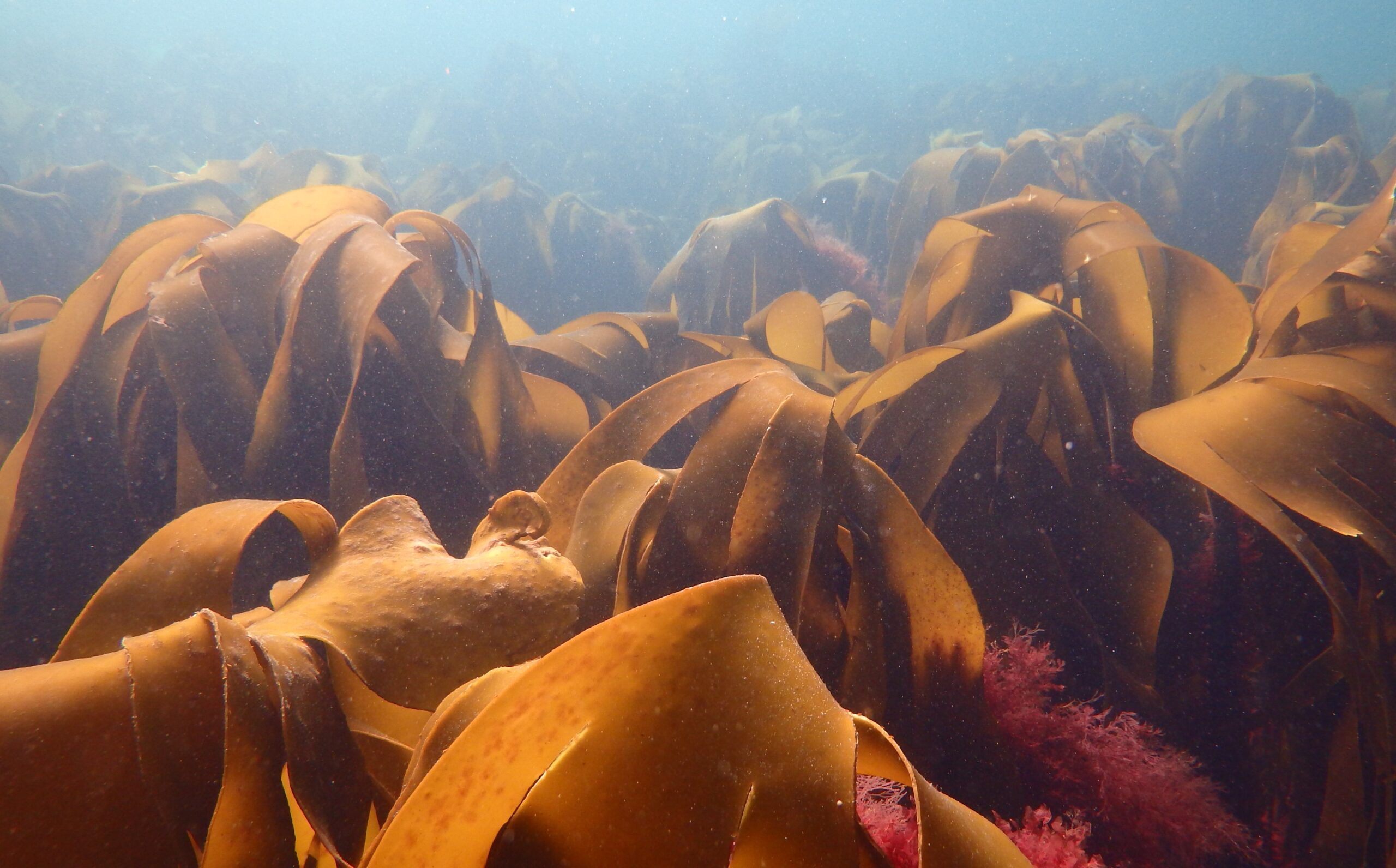
Kelp forests along the UK coastline are more resilient to disturbance than previously thought, according to a study recently published in the Journal of Ecology.
MBA researchers conducted a six‑year experiment across a 1,000 km stretch of the northeast Atlantic, spanning from northern Scotland to southern England, to test how kelp ecosystems respond to disruption and increasing ocean temperatures.
By experimentally removing kelp from large seabed plots and tracking recovery over time, the team assessed multiple aspects of ecological ‘stability’, including resistance, resilience (rate of recovery), and overall recovery.
Encouragingly, kelp forests dominated by Laminaria hyperborea showed strong recovery across all regions. Kelp density and canopy cover returned within just 2 to 3 years, while the full structure of the forest – including biomass and canopy height – generally recovered within 3 to 6 years.
Regional differences in kelp recovery
The findings from the study – Stable and resilient kelp forests across a latitudinal gradient of thermal stress – highlight the natural capacity of these ecosystems to bounce back after physical disturbance, such as storms. Rapid regrowth was supported by high recruitment of young kelp and the proximity of surrounding forests supplying new individuals.
However, the study also identified important regional differences. Recovery was slower in warmer southern locations, where temperatures are closer to the kelp’s upper tolerance limits. In some cases, growth and biomass recovery were up to six times slower than in cooler northern regions.
This suggests that while UK kelp forests remain stable today, southern populations may become increasingly vulnerable as ocean temperatures rise.
Implications for long-term ecosystem recovery
Notably, researchers found no evidence that disturbed areas shifted to alternative ecosystems such as turf algae or urchin-dominated ‘barrens’, which are a concern in many parts of the world. Laminaria hyperborea instead consistently re-established dominance across all sites.
The study emphasises that measuring ecosystem recovery requires looking beyond surface-level indicators. While kelp cover returned quickly, full ecological function – such as carbon storage and habitat complexity – took significantly longer to recover.
Conservation matters in a warming ocean
Overall, the research provides valuable insight for marine conservation and management. It shows that kelp forests can remain resilient under current conditions, but also warns that this resilience may weaken under continued climate change and repeated disturbances.
Lead author, MBA Postdoctoral Research Assistant Dr Nathan King, said: “As pressure on marine ecosystems increases, understanding how key habitats recover is critical for protecting biodiversity and the vital services kelp forests provide.”