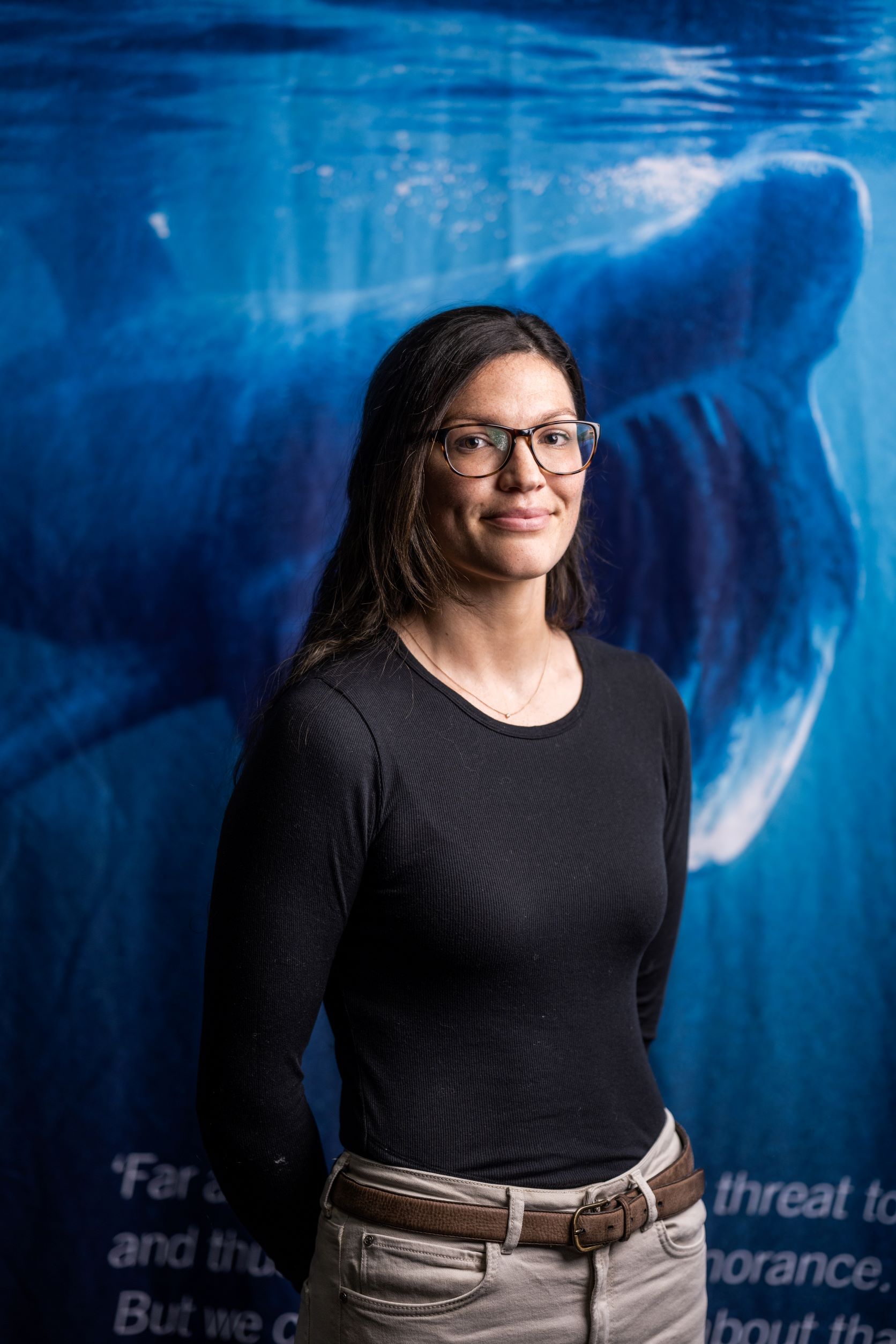
The Marine Biological Association (MBA) is delighted to welcome Dr Amy Courtney as our new Anne Warner Research Fellow, strengthening the MBA’s internationally recognised programme of discovery science and its long tradition of using marine life to unlock fundamental biological insights.
Amy is an evolutionary neuroscientist whose work explores one of biology’s most fascinating questions: how complex nervous systems are built, organised and adapted to support behaviour. By studying marine animals with uniquely evolved brains and senses, her research sheds new light on how vision and neural communication work across the animal kingdom.
A career shaped by curiosity and marine science
Amy completed her PhD at University College Dublin, where she worked with comb jellies – simple marine animals that offer powerful clues about the early evolution of nervous systems. She later joined William Schafer’s laboratory at the MRC Laboratory of Molecular Biology in the UK, where she spent several years studying the developing visual system of the common octopus, one of the most intelligent invertebrates on the planet.
Amy has built a reputation for combining cutting‑edge molecular biology with innovative use of marine organisms, and her work has taken her across Europe, including collaborating closely with researchers at KU Leuven in Belgium. This breadth of experience is welcomed as an invaluable contribution to the MBA’s interdisciplinary research environment.
Unlocking the secrets of vision and brain evolution
At the MBA, Amy will focus on understanding how visual circuits in cephalopods — such as octopus and cuttlefish — are organised at the molecular and cellular level. Cephalopods rely heavily on vision to navigate their environments, hunt, communicate and camouflage, yet their nervous systems evolved independently from those of vertebrates, including humans.
By comparing how different species process visual information, Amy’s research aims to reveal shared principles of brain function as well as unique evolutionary solutions. In previous work, she identified previously unknown types of neurotransmitter receptors involved in octopus vision, opening new avenues for understanding how nerve cells communicate. Her MBA research will explore whether similar mechanisms are found across related species, helping scientists understand how complex brains can be assembled in different ways.
Why this research matters
Although inspired by marine life, Amy’s work has implications far beyond the ocean. Understanding how nervous systems are organised helps inform fields ranging from biomedical research and neurotechnology to artificial intelligence, where biological principles often inspire new approaches to computation and sensing.
Her research also reinforces the value of marine organisms as powerful models for discovery science, which is one of the core strengths of the MBA. By studying animals that challenge our assumptions about how brains ‘should’ work, Amy’s work helps broaden scientific thinking and encourages innovative, cross‑disciplinary approaches to some of biology’s biggest questions.
“I am delighted to be joining the MBA. I first visited in 2016 during my
PhD, when I attended the Electrophysiology course and collaborated with the lab of Pawel Burkhardt,” says Amy. “What struck me then was the strong sense of community and shared passion for marine science. It is a real privilege to now be part of your community, and I am looking forward to getting to know everyone. I am especially excited to contribute to the MBA’s legacy
of working with cephalopods, and for the discoveries that lie ahead.”

A unique addition to the MBA community
Amy brings a rare combination of deep technical expertise, evolutionary perspective and collaborative experience to the MBA. She will contribute to the organisation not only through her research, but also through mentoring early‑career scientists, strengthening international collaborations, and championing the use of marine systems to address fundamental biological problems.
Her appointment continues the MBA’s commitment to supporting ambitious, curiosity‑driven researchers whose work has the potential to influence science well beyond their immediate field.
About the Anne Warner Research Fellowship
The Anne Warner Research Fellowship is an endowed position established through a generous legacy from Professor Anne Warner FRS, a pioneering cell biologist and long‑standing supporter of the MBA. Professor Warner was a Professor at University College London, a former Foulerton Professor of the Royal Society, and a passionate advocate for the use of marine organisms to uncover fundamental biological principles.
Professor Warner had a close association with the MBA as a visiting researcher and Vice‑President, and her legacy continues to support independent, high‑quality research in marine cell and molecular biology. The Fellowship enables outstanding scientists to establish innovative research programmes at the MBA, ensuring that Professor Warner’s vision for discovery science and mentorship lives on through future generations of marine biologists.
Help protect the ocean with a Gift in your Will
Remembering the Marine Biological Association with a Gift in your Will is a meaningful act of kindness and an extraordinary way to celebrate your life and leave a lasting legacy.
Just like Anne Warner, your legacy will fuel discovery through world-leading marine research, inspire the marine scientists of the future and protect our ocean, ensuring it can thrive for generations to come. Find out more here.