A new study co-authored by the Marine Biological Association’s Senior Research Fellow Dr Dan Smale, Lankester Research Fellow Professor Stephen J. Hawkins, Postdoctoral Research Assistant Dr Nathan King, and former PhD student Harry Teagle, has revealed how the loss of kelp forests at their southern range edge could dramatically reshape marine ecosystems.
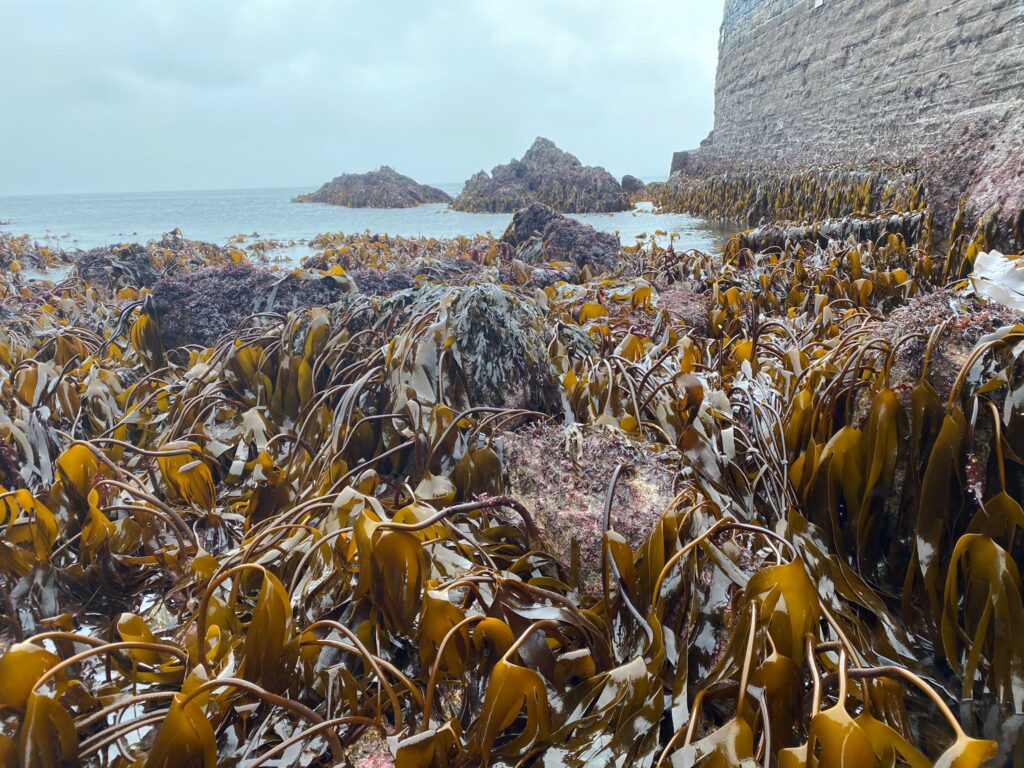
Dense patches of kelp on rocky shore. c. Marine Biological Association
The study, Foundation species loss alters algal community structure and dynamics at a trailing range edge, published in the Journal of Ecology, looked at what happens when kelp (Laminaria digitata), a key marine species, is lost from rocky shores in southwest England. The researchers simulated an intense canopy disturbance and then tested three recovery scenarios, by controlling the density of Laminaria digitata recruiting into disturbed areas. They tracked changes over 2.5 years at two sites, one wave-exposed (Bovisand Reef) and one sheltered (Firestone Bay). Results showed:
1. When kelp could regrow naturally (no removal of Laminaria digitata recruits):
- The ecosystem bounced back quickly.
- Kelp density and cover returned to pre-disturbance levels within a year or two.
2. When kelp recovery was limited (removal of half or all of Laminaria digitata recruits to simulate partial or complete loss of this species at the range edge):
- Biomass dropped sharply, up to 56% less at the sheltered site and 47% less at the exposed site.
- The whole community changed; other seaweeds took over, including short-lived opportunistic species and even invasive kelp (Undaria pinnatifida).
- At the exposed site, a fast-growing ‘pseudo-kelp’ (Saccorhiza polyschides) dominated, creating a less stable habitat that disappears seasonally.
- At the sheltered site, a mixed canopy formed, including non-native species, which could increase invasion risks.
Why does this matter?
Losing cold-adapted perennial kelp species like Laminaria digitatameans losing a stable, year-round habitat. Opportunistic species don’t provide the same shelter or food, and they change how carbon and nutrients flow through the ecosystem, potentially affecting biodiversity, fisheries, and even carbon storage, which is vital for climate regulation.
Senior author Dan Smale said: “We know that kelp species are declining in many regions around the world as a consequence of ocean warming and other stressors, but it’s harder to know what the wider implications are for the ecosystem. By conducting a long-term manipulative field experiment within a real, complex temperate reef system, we were able to show that the loss of a key foundation species changes the whole community and key ecological processes, such as post-disturbance recovery, biodiversity maintenance, and carbon and nutrient cycling.”
The results of the study underscore the importance of prioritising marine habitat protection in climate adaptation strategies, supporting long-term monitoring programmes to detect early signs of ecosystem tipping points, and recognising the urgent need for proactive conservation strategies to safeguard these critical habitats before irreversible changes occur.
