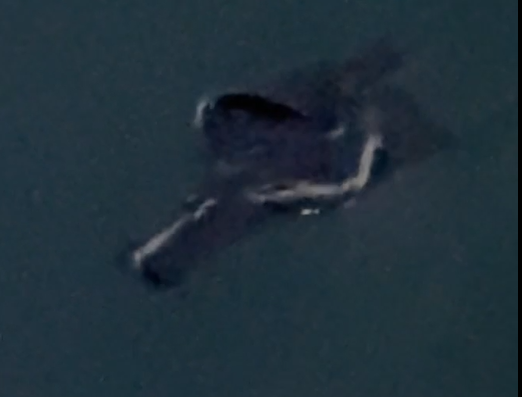
A Plymouth fisherman has captured remarkable footage of a large sea hare gliding through the waters of the Barbican, offering a rare glimpse of an unusual marine visitor swimming freely in one of the city’s busiest waterfront settings.
The encounter took place outside Bar Rakuda on Plymouth’s historic waterfront over the late August Bank Holiday weekend, when local student and fisherman Charlie Hill spotted a large dark creature moving through the water. The animal, estimated to be around 30cm/1 foot long, appeared to be grazing on algae from the harbour wall before swimming out into open water.
Marine expert’s second look reveals exciting discovery
Scientists from the Marine Biological Association (MBA) in Plymouth first thought it may be species more commonly seen in UK waters, but it is now believed that the mysterious marine animal is one rarely seen before in British coastal waters and one more commonly associated with the Mediterranean and warmer seas further south. Sightings here remain relatively uncommon, making the Devon coastal encounter a significant one.
MBA Research Aquarium Manager Alix Harvey said: “When I first viewed the footage, I thought the animal was Aplysia punctata, a species of sea hare that is relatively common around UK coasts. However, after studying the video more closely, I realised it was actually Aplysia fasciata, also known as the black sea hare. The clues were its impressive size and the distinctive way it used its parapodia, the wing-like flaps along the sides of its body, as it swam through the water. Discovering that it was Aplysia fasciata was really exciting because sightings of this species in UK waters are still relatively uncommon.”
An unusual visitor from warmer seas
At first glance, sea hares can appear distinctly unglamorous. Resting on rocks or harbour walls, they resemble oversized black slugs, with soft bodies and few obvious distinguishing features. But in common with penguins and seals in being ungainly on land, beneath the surface, the footage reveals an entirely different animal moving gracefully through the water.
As the creature swims, broad wing-like flaps (parapodia) gently undulate along its body, propelling it through the water with remarkable grace. The footage is striking for two reasons: not only does it capture a rarely observed swimming display, but it also documents a species that remains a rare sighting in UK shores.
“I love finding out anything I can about what’s living in our seas,” said Charlie, who works on Plymouth’s Barbican and spends much of his spare time fishing. “I’d never seen anything quite like this before, so I thought it was worth sharing.”
The species is native to the Mediterranean Sea and parts of the eastern Atlantic, where it inhabits warmer coastal environments and grazes on algae. In recent years, however, marine scientists have observed a growing number of species traditionally associated with southern waters appearing further north around the UK. Most notable of these is the unprecedented prolonged period of sightings and catches of Common octopus (Octopus vulgaris) off the coasts of Devon and Cornwall since early 2025. Recent reports indicate that octopus have spread from where they were last year and are now being caught on both the south and north coasts of Devon and Cornwall, with additional sightings as far afield as Dorset, East Sussex, and Wales.
While a single sighting cannot on its own be attributed to climate change, records of warm-water species in British seas are becoming increasingly important indicators of how marine ecosystems are responding to rising ocean temperatures. The appearance of Aplysia fasciata in Plymouth adds to the wider picture of changing species distributions and shifting habitats as waters around the UK continue to warm.
Citizen scientists play key role in tracking marine species
Charlie’s sighting highlights the vital role members of the public play in helping scientists understand the changing marine environment. Observations submitted by fishermen, divers, sailors and coastal communities provide valuable information about species distributions and can alert scientists to unusual arrivals or emerging trends.
Marine experts are encouraging anyone who encounters unusual wildlife to photograph it, note the location and depth if possible, and report their sighting to DASSH, the Marine Biological Association’s data experts, through the iNaturalist app, so specialists can track species and how changing marine habitats are influencing the movement of marine life.
“Every record helps us build a better understanding of how marine species are distributed and whether their ranges may be changing,” adds Alix. “It’s fantastic that Charlie took the time to film the animal and share the footage, allowing us to identify such a remarkable visitor to Plymouth’s waterfront.
“For a marine biologist, it’s always a thrill when a second look reveals something rarer than expected, and this black sea hare certainly gave us that moment.”
The footage offers a fascinating glimpse into the hidden world beneath one of Plymouth’s busiest waterfronts, where warming seas are bringing new and unexpected marine life into new locations and changing marine ecosystems. Extraordinary wildlife can often be found in the most unexpected places.
Photo and video credit: Charlie Hill