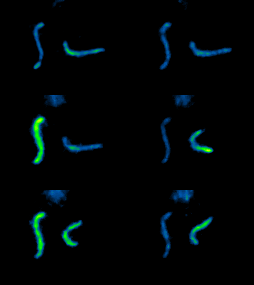
Single-celled algae are essential for life on our planet, but they aren’t often associated with pioneering breakthroughs in neuroscience. However, this year’s Nobel Prize for medicine, awarded to Peter Hegemann, Georg Nagel and Karl Deisseroth for research into ‘light-gated ion channels and optogenetics’ came directly from work examining the swimming of tiny green algae.
Peter Hegemann was fascinated by how motile green algae, such as the pond-dwelling Chlamydomonas, were able to swim towards or away from a light source. Light is essential for photosynthetic organisms, so it’s not surprising that algae have evolved mechanisms for sensing light, although little was known about how this was achieved. Initial studies identified that Chlamydomonas cells possessed a pigment-containing eyespot that allowed them to detect changes in light intensity and direction. Working together with Georg Nagel, Peter Hegemann identified that the eyespot activated anovel protein known as channelrhodopsin, an ion channel that forms a pore in the cell membrane and allows ions to pass in and out of the cell. Ion channels are found in all cells, and they control many of our sensory responses, including touch, taste, vision and hearing. However, channelrhodopsin was unique because it was the only ion channel that could be controlled directly by flashes of light.
In discovering how single-celled organisms can sense light, the scientists had already made a major breakthrough. However, they quickly realised that this unique protein could be used as a tool to control the activity of animal neurons. If channelrhodopsin could be expressed in nerve cells using genetic techniques, then researchers could manipulate the electrical activity of specific neurons just by using flashes of light. This remarkable approach became known as ‘optogenetics’ and revolutionised the way neuroscientists were able to investigate brain function, allowing them to identify which groups of nerve cells are involved in individual responses, like memory, sleep or movement. Channelrhodopsin may have also have further uses in biomedicine and is showing promise in gene therapy approaches to restore vision in damaged human retina.
The work of the Nobel Prize winning scientists completely revolutionised neuroscience, allowing the vast complexity of animal brains to be probed in ways that were not previously imaginable. Many more types of channelrhodopsins have since been discovered in different algae, including many of the important phytoplankton groups that support life in our oceans. These novel proteins have distinct properties from the Chlamydomonas protein, such as sensitivity to different wavelengths of light, allowing the development of further innovative tools for neuroscience. However, whilst neuroscientists have eagerly exploited this novel toolset, the roles of these ion channels in their native algae remains largely unexplored. It will be fascinating to identify the many ways in which single-celled algae are able to utilise light-sensing in their natural habitat.
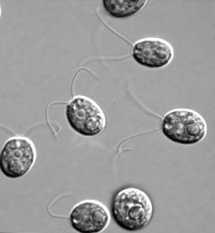
Much of our current research at the MBA examines how marine algae respond to their environment. We study how major phytoplankton groups such as diatoms and coccolithophores cope with changes in temperature, nutrients, light and salinity. In many respects this mirrors the early work of Peter Hegemann examining how Chlamydomonas was able to respond to changes in light. Like Peter Hegemann, we have discovered unique signalling processes in these algae, including several novel classes of ion channels with unexpected properties. Perhaps the most surprising of these was the presence of a unique class of Na+ channels in calcifying coccolithophores that evolved independently but have many similar properties to animal Na+ channels that underpin brain function and neurotransmission.
We don’t yet know what all of these ion channels do, although research shows that many of them play critical roles in algal biology, allowing them to rapidly respond to changes in their environment. Understanding the native function of these ion channels in algae is therefore fundamentally important, allowing us to determine the processes controlling productivity in marine ecosystems and how these may be impacted in the future. However, it is likely that the huge diversity of algal ion channels will also offer many further opportunities for biotechnological and biomedical applications, beyond those already found for channelrhodopsin. One example is the coccolithophore Na+ channel, which has potential in gene therapy approaches to tackle defects in electrical signalling in the human heart and overcome cardiac arrythmias.
Our detailed knowledge of life on our planet is understandably skewed towards humans and the terrestrial ecosystems that support them. In comparison, much remains to be learnt about the huge diversity of life in aquatic ecosystems, particularly in the remote oceans. The work of Peter Hegemann and co-workers is a wonderful example of how studying and understanding that diversity can lead to unexpected and revolutionary progress in completely distinct research areas.
Dr Glen Wheeler, Senior Research Fellow
Dr Katherine Helliwell, Senior Research Fellow
Professor Colin Brownlee, FMBA, FLS, Lankester Research Fellow