Scientists at the Marine Biological Association (MBA) have published new research revealing how an ancient group of aquatic fungi builds their cell walls, providing fresh insights into fungal evolution and establishing a little-studied aquatic fungus as an important model system for future bioscience research.
Published in the new journal npj Fungal Science, the study, Cell wall forming chitin synthases in a chytrid fungus, by Dr Trupti Gaikwad and Professor Michael Cunliffe, focuses on the chytrid fungus Rhizoclosmatium globosum, an ecologically important fungus that helps recycle organic matter in aquatic ecosystems.
Advanced tools for understanding aquatic life
A major aim of the project was to develop genetic tools that would allow researchers to observe gene activity directly inside living chytrid cells.
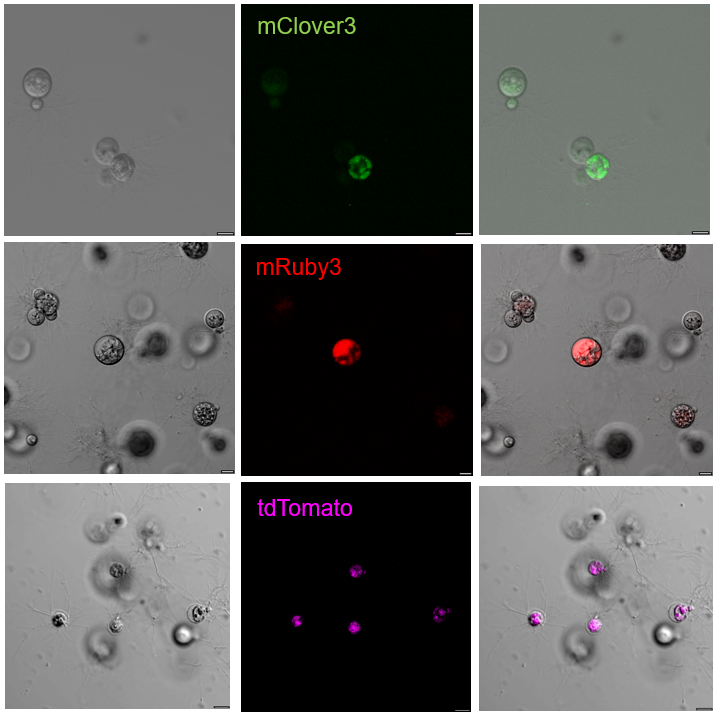
Using two approaches widely applied at the MBA – genetic transformation and confocal microscopy – they generated fluorescently tagged chitin synthases, allowing key cell wall-forming enzymes to be visualised during different stages of fungal development.
The transformed cells were examined using the MBA’s advanced confocal microscopy facilities, which enabled the researchers to capture fluorescent signals in remarkable detail and reconstruct three-dimensional views of the cells, layer by layer. By combining molecular biology, genetic transformation and advanced imaging, the team was able to link gene activity with cell development in real time.
Seeing transformed chytrid cells glow under the microscope for the first time provided clear evidence that these new genetic tools were working in a species where this approach had not previously been established. Distinct patterns of localisation were observed, including strong activity around structures involved in cell wall formation and development.
“One of the most exciting parts of this work was seeing fluorescent signals under the microscope for the first time. It meant we could watch where important cell-wall proteins were active inside this tiny organism,” said Dr Gaikwad.
A model for understanding aquatic fungi
While fungi are often associated with forests, soils or disease, many species live in aquatic environments, where they play vital roles in breaking down organic matter and supporting food webs. Chytrids are particularly important because they produce swimming spores that allow them to move through water and colonise new food sources.
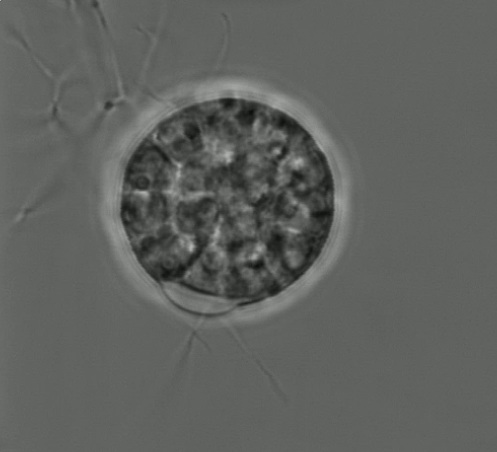
At the MBA, researchers are using R. globosum as a model organism to explore fundamental questions in fungal cell biology. Unlike the pathogenic chytrid fungus associated with amphibian declines, R. globosum is a free-living species that helps decompose chitin, a tough natural material found in the shells of crustaceans and other aquatic organisms.
Studying an evolutionarily distinct fungi
Much of what scientists know about fungal biology comes from more familiar fungal groups such as yeasts. Chytrids, however, form one of the earliest branches of the fungal tree of life, making them evolutionarily distinct and scientifically valuable.
By studying these early fungi, researchers can investigate how fundamental features of fungal cells evolved and how they function in aquatic environments.
The MBA team focused on chitin synthase genes, which encode enzymes responsible for building fungal cell walls. Chitin is a major structural component of fungal cells, and understanding where and when these genes are active provides important clues about how fungal cells grow, develop and maintain their structure.
Why this research matters
Although microscopic, chytrid fungi are powerful recyclers within aquatic ecosystems. By breaking down complex materials such as chitin into simpler compounds, they help make nutrients available to other microorganisms and contribute to the functioning of food webs.
By improving understanding of how these fungi grow and function, the research provides foundational knowledge about an ecologically important but relatively understudied group of organisms. This knowledge could help inform future research into ecosystem health, biodiversity and the monitoring of environmentally important fungi.
“In developing R. globosum as a ‘model’ chytrid – combining modern microscopy with genetic and genomic approaches – we are uncovering the basic cell biology of chytrids, such as how they build their cells and grow,” explains Professor Cunliffe. “This kind of fundamental research helps us interpret how chytrids behave in nature and could guide future work on monitoring and managing chytrid impacts.”
The work also demonstrates the strength of the MBA’s scientific infrastructure, including its molecular biology laboratories, genetic transformation capabilities and advanced imaging facilities, which enable researchers to undertake cutting-edge research in non-traditional model organisms.
Delivering the MBA Royal Charter
This study is an example of the fundamental bioscience that sits at the heart of the MBA’s Royal Charter. While the research does not seek an immediate practical application, it addresses basic scientific questions about how living cells function, grow and evolve.
By investigating an aquatic organism, the research contributes directly to understanding life in marine and freshwater environments, advancing knowledge of the biological processes that underpin healthy ecosystems. This reflects the MBA’s long-standing mission to promote and undertake scientific research into marine and aquatic life for the benefit of society.
“By understanding how chytrid cells grow, divide and build their walls, we can learn more about fungal evolution and the basic biology that supports life in aquatic environments,” says Dr Gaikwad. “For me, the value of this research is that it opens the door to studying an important but underexplored group of fungi. These organisms are small, but they play powerful roles in nature.”
By investing in advanced scientific capabilities and fundamental curiosity-driven discovery science, the MBA is helping to build the knowledge base that underpins future environmental, ecological, biological and evolutionary research.
Building a model system for aquatic fungal bioscience
This latest paper builds on several recent MBA studies using R. globosum to understand how aquatic fungi function and evolve. Previous research has explored how the fungus detects, colonises and breaks down chitin in aquatic environments, revealing the adaptations that allow it to play an important role in nutrient recycling. Together with the new study of fungal cell wall formation, this growing body of work is helping to establish R. globosum as a model organism for fungal bioscience.
The next stage of the research will explore the roles of additional chitin synthase genes and investigate how they function at different stages of the chytrid life cycle, from swimming spores through to mature cells.
The project was supported by the European Research Council (ERC) through the MYCO‑CARB project, reinforcing the MBA’s role as an international centre for curiosity‑driven research.
Read the paper in full: Gaikwad, T. & Cunliffe, M. (2026) Cell wall forming chitin synthases in a chytrid fungus. npj Fungal Science.
Further reading:
Chrismas N, Bird K, Laundon D, Lieng C, Hesketh-Best P and Cunliffe M (2025) Adaptive traits for chitin utilization in the saprotrophic aquatic chytrid fungus Rhizoclosmatium globosum. Proc Biol Sci. 292(2047):20250337. doi: 10.1098/rspb.2025.0337.
Laundon D, Chrismas N, Bird B, Thomas S, Mock T and Cunliffe M (2022) A cellular and molecular atlas reveals the basis of chytrid development eLife 11:e73933. https://doi.org/10.7554/eLife.73933
Laundon D and Cunliffe M (2021) A call for a better understanding of aquatic chytrid biology. Front. Fungal Biol. 2:708813. doi: 10.3389/ffunb.2021.708813
Laundon D, Chrismas N, Wheeler G and Cunliffe M (2020) Chytrid rhizoid morphogenesis resembles hyphal development in multicellular fungi and is adaptive to resource availability. Proc Biol Sci. 287(1928):20200433. doi: 10.1098/rspb.2020.0433.
Roberts C, Allen R, Bird K and Cunliffe M (2020) Chytrid fungi shape bacterial communities on model particulate organic matter. Biol Lett. 16(9):20200368. doi: 10.1098/rsbl.2020.0368.
