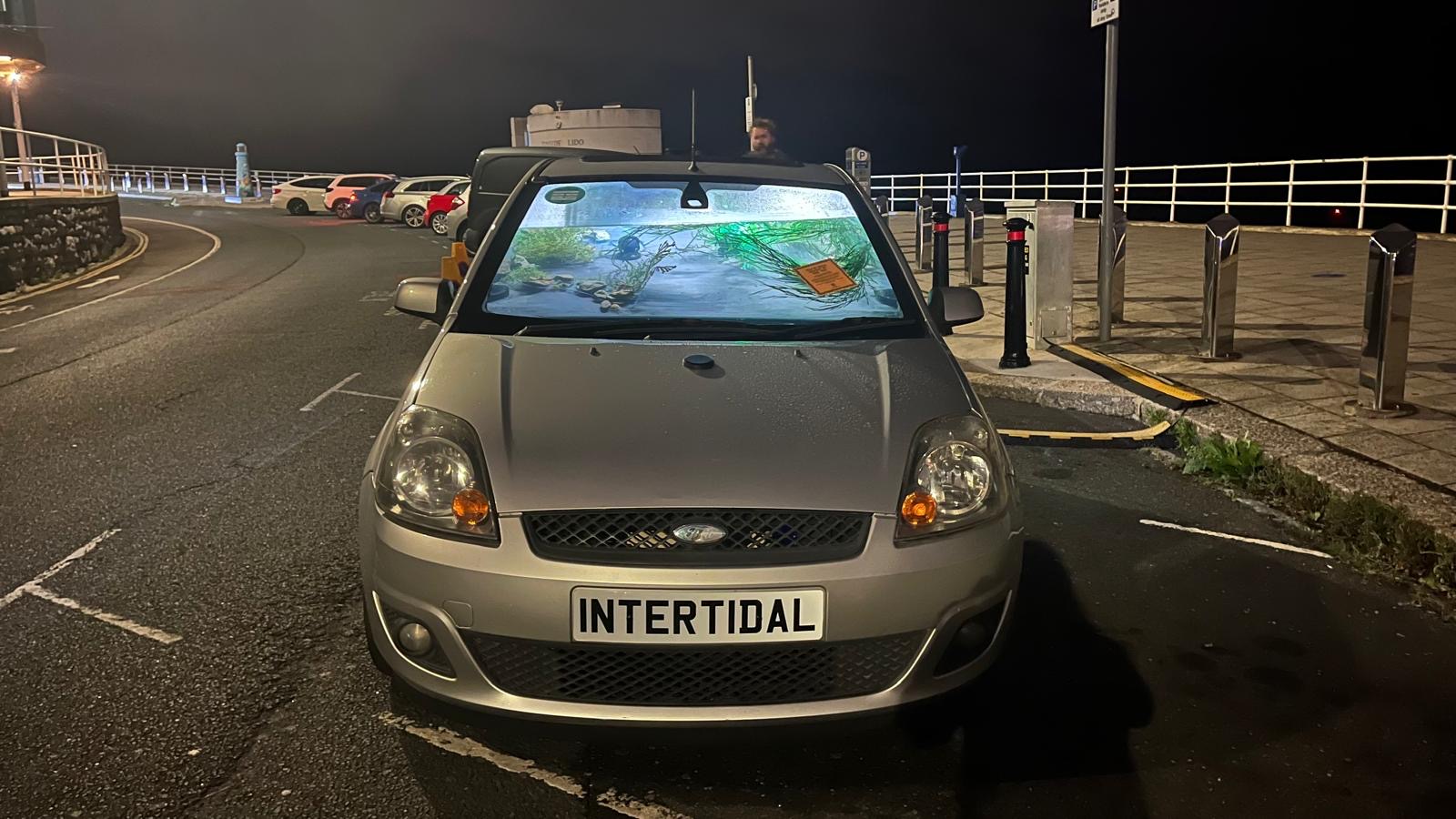
Parked outside the Marine Biological Association (MBA) a 20-year-old Ford Fiesta filled with seawater was quietly demonstrating the hidden forces that shape life along Plymouth’s coastline.
The sea-filled vehicle was not a prank or publicity stunt, but the prototype for Intertidal, an ambitious artwork by artist David Cotterrell that combines art, engineering and marine science to make the city’s tidal rhythms impossible to ignore.
As part of his exhibition, David envisioned a range of cars supporting marine life adapted to the changing conditions of the shore. Rather than fish or larger animals, he was interested in organisms such as salt-tolerant plants and macroalgae that naturally inhabit the intertidal zone.
Creating a car that behaves like an intertidal habitat proved far more complicated than simply filling it with seawater. Each Fiesta had to be stripped back, sealed and rebuilt. “It was enormously complex,” said David. “It behaves like a little lab experiment; pumps move water between hidden and visible spaces, while sensors monitor conditions and relay data about the system’s performance.” Filtration equipment, batteries and remote controls ensure the installation can operate safely and reliably in public spaces.
But the big question was – if a car was to function as an intertidal habitat, what could actually survive inside it? That brought the prototype to the Marine Biological Association (MBA), at Citadel Hill in Plymouth. “I came here because this organisation is one of the centres for expertise in marine life,” David explained.
Working with scientists at the MBA’s Research Aquarium, David sought guidance on species selection, water quality, filtration, lighting and tidal cycling. Their expertise helped inform how a sustainable miniature habitat could be created within such an unusual environment.
Research Aquarium Manager Alix Harvey said: “One of the best parts of working in the MBA’s research aquarium is you never know what the next new project could be and what sort of problems you’ll need to solve. Whilst designing bespoke experimental aquaria systems is not usual for our team, I can’t say we ever envisaged seeing one in a Ford Fiesta. Getting to see the inner workings of David’s creation, providing advice and assisting with the test runs was a surprising highlight of our summer. Marine biologists in general are quite a creative bunch and there’s often a lot of cross over between science and art – Cotterrell’s Intertidal is a perfect example.”
Commissioned through Plymouth Culture’s Sea for Yourself programme, Intertidal transformed four ageing Ford Fiestas into living, tide-responsive environments which fill and empty with seawater according to the rise and fall of Plymouth’s tides. Familiar from the outside, the cars become something entirely different when viewed through the windows: miniature aquatic worlds that bring the shoreline into the heart of the city.
Raised in suburban east London, David described himself as “quite urban”. Although he grew up close to the Thames Estuary, the waterway felt distant and inaccessible. “The biggest revelation was how little I learned at school about the ocean…the sea felt like somebody else’s world,” he recalls. It was only later, after moving onto a boat on the Thames, that he began to appreciate the complex rhythms of the river and its tidal movements.
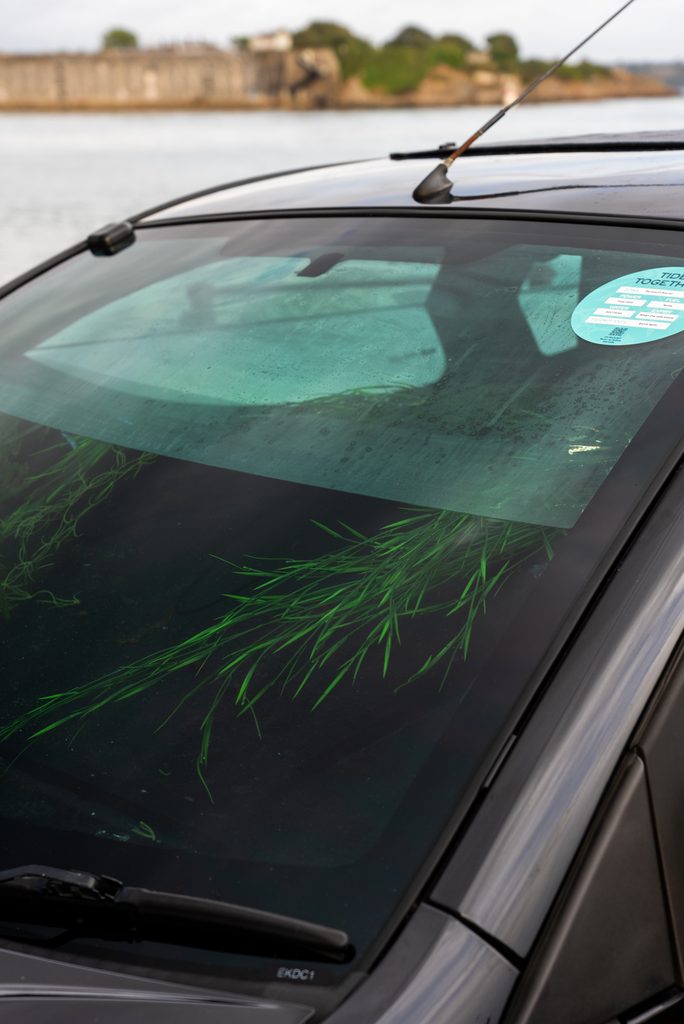
That sense of discovery sparked a fascination with the natural processes that often pass unnoticed beneath urban life. In Plymouth, a city shaped by the sea, he saw an opportunity to make those invisible connections visible once again.
Through a combination of engineering, ecology and artistic imagination, Intertidal suggests that the answer may be far less obvious than we think. In a city built around the water, the tide is never far away, even when it appears to be parked at the side of the road.
“The cars only really become alive if they’re part of the conversation,” said David. “By placing that tidal movement inside something as ordinary as a car, I wanted to create a moment that feels both familiar and completely unexpected. If someone stops, looks twice and begins to wonder where the sea really ends and the city begins, then the artwork is doing what I hoped it would.”
The first four Intertidal cars can now be seen at:
Tinside – Plymouth Hoe
Mount Batten Car Park – Mount Batten
The Box – Tavistock Place
Mount Edgcumbe – beside the Plymouth Boat Trips ferry landing
Throughout September and October, the cars will move to new locations, taking Intertidal into different communities and landscapes.